Category Archives: T-Mobile

The US Wireless Market in Q3 2016

One of the markets I follow most closely is the US wireless market. Every quarter, I collect dozens of metrics for the five largest operators, churn out well over a hundred charts, and provide analysis and insight to my clients on this topic. Today, I’m going to share just a few highlights from my US wireless deck, which is available on a standalone basis or as part of the Jackdaw Research Quarterly Decks Service, along with some additional analysis. If you’d like more information about any of this, please visit the Jackdaw Research website or contact me directly.

Postpaid phones – little growth, with T-Mobile gobbling up most of it

The mainstay of the US wireless industry has always been postpaid phones, and it continues to account for over half the connections and far more than half the revenues and profits. But at this stage, there’s relatively little growth left in the market – the four main carriers added fewer than two million new postpaid phone customers in the past year, a rate that has been slowing fairly steadily:

postpaid-phone-net-adds-for-big-4This was always inevitable as phone penetration began to reach saturation, and as the portion of the US population with good credit became particularly saturated. But that reality means that future growth either can’t come from postpaid phones, or has to come through market share gains almost exclusively.

In that context, then, T-Mobile has very successfully pursued the latter strategy, winning a disproportionate share of phone customers from its major competitors over the last several years. The chart below shows postpaid phone net adds by carrier:postpaid-phone-net-adds-by-carrier
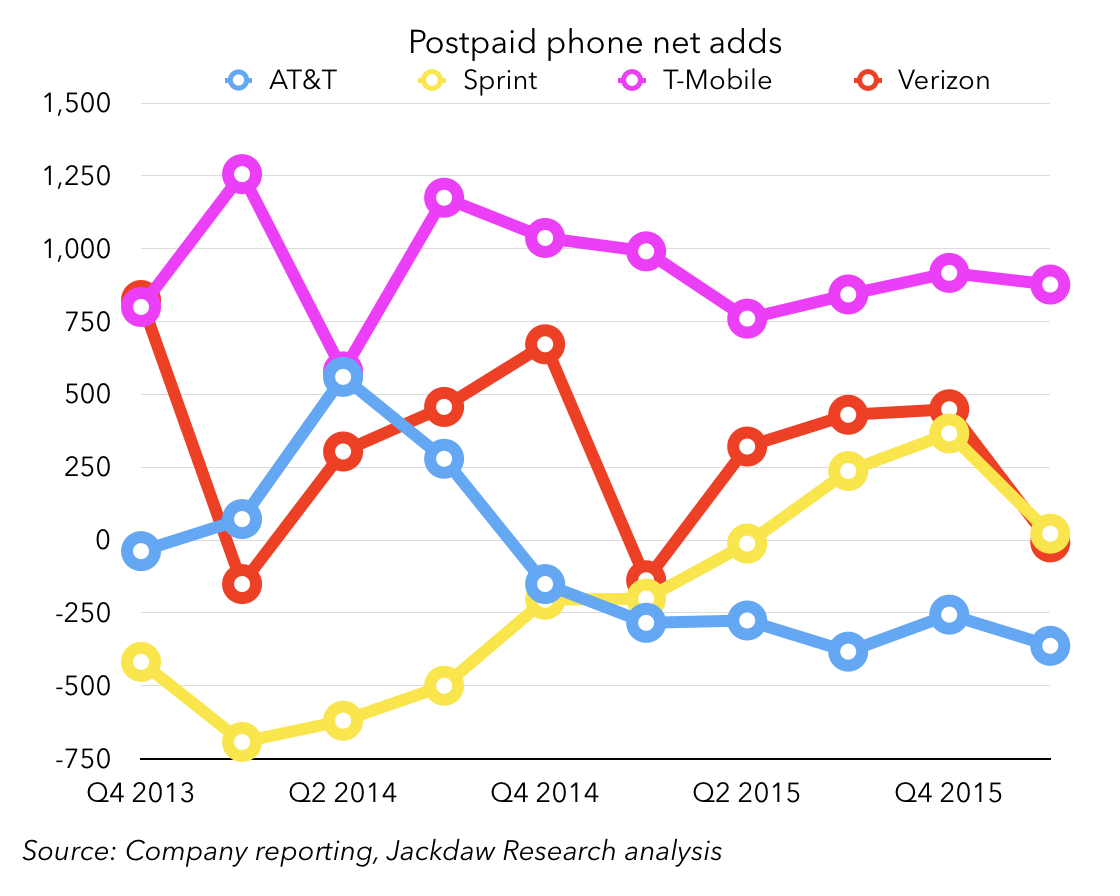
As you can see, T-Mobile is way out in front for every quarter but Q2 2014, when AT&T preemptively moved many of its customers onto new cheaper pricing plans. AT&T has been negative for much of the last two years at this point, while Sprint has finally returned to growth during the same period, and Verizon has seen lower adds than historically. What’s striking is that T-Mobile and Sprint have achieved their relatively strong performances in quite different ways. Whereas Sprint’s improved performance over the past two years has been almost entirely about reducing churn – holding onto its existing customers better – T-Mobile has combined reduced churn with dramatically better customer acquisition.

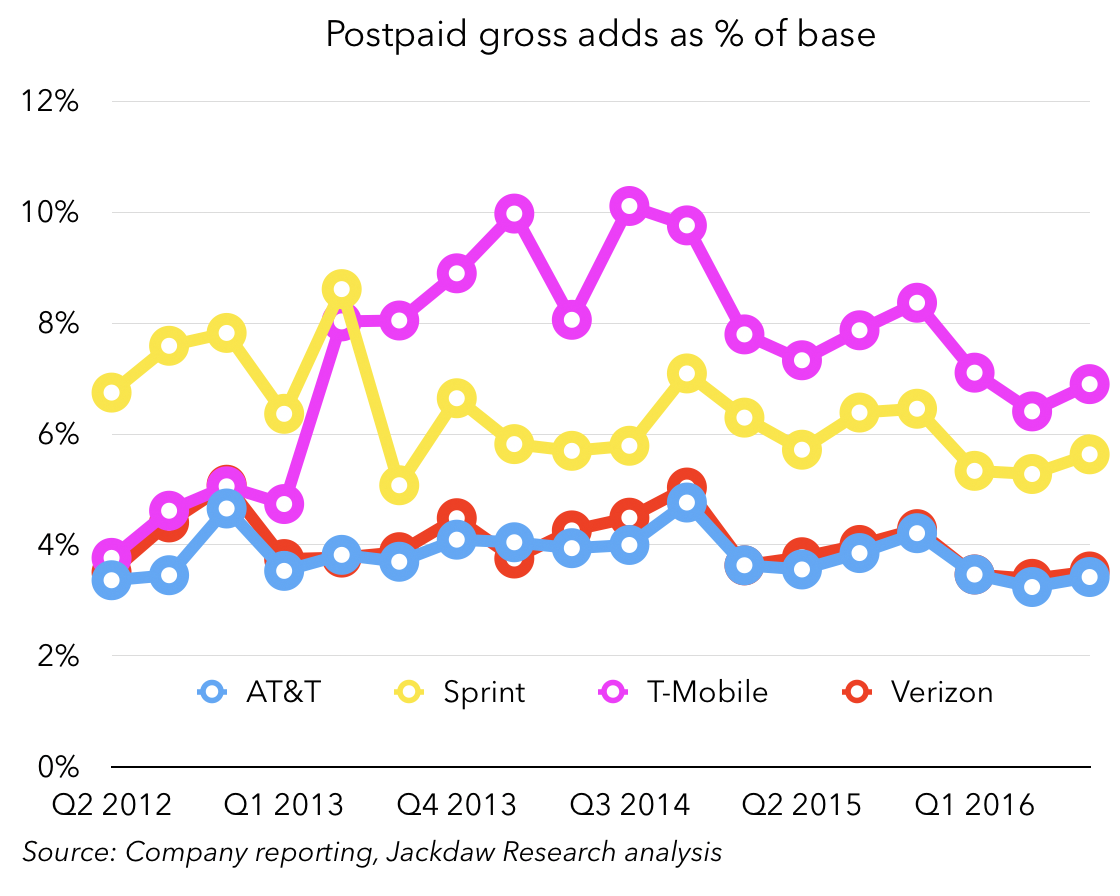
The carriers don’t report postpaid phone gross adds directly, but we can derive total postpaid gross adds from net adds and churn, and I find the chart below particularly striking:
gross-adds-as-percent-of-base

What that chart shows is that T-Mobile is adding far more new customers in proportion to its existing base than any of the other carriers. Sprint is somewhat close, but AT&T and Verizon are far behind. But the chart also shows that this source of growth for T-Mobile has slowed down in recent quarters, likely as a direct effect of the slowing growth in the market overall. And that slowing gross adds number has translated into lower postpaid phone net adds over the past couple of years too:
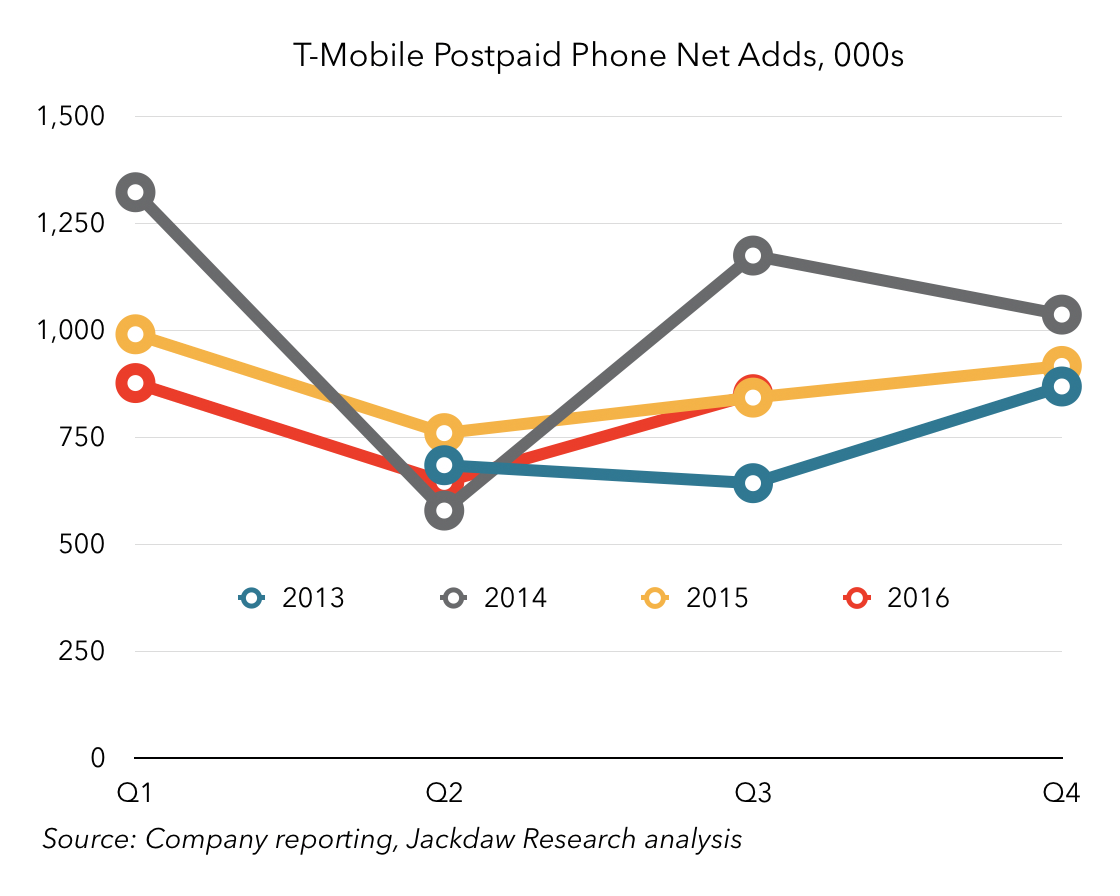
t-mobile-postpaid-phone-net-adds-by-quarter

That’s a bit of an unconventional chart, but is shows T-Mobile’s postpaid phone net adds on an annual basis, so you can see how each year’s numbers compare to previous years’. As you can see, for most of 2015 and 2016, these net adds were down year on year. The exceptions were again around Q2 2014, and then the quarter that’s just ended – Q3 2016, when T-Mobile pipped its Q3 2015 number ever so slightly. The reason? Likely the launch of T-Mobile One, which I wrote about previously. The big question is whether T-Mobile will return to the declining pattern we saw previously when the short-term effects of the launch of T-Mobile One wear off.

Smartphone sales – slowing on postpaid, holding up in prepaid

All of this naturally has a knock-on effect on sales of smartphones, along with the adoption of the new installment plans and leasing, which are breaking the traditional two-year upgrade cycle. The number of new smartphones in the postpaid base has been slowing dramatically over the last couple of years too:

year-on-year-growth-in-postpaid-smartphone-base

But the other thing that’s been happening is that upgrade rates have been slowing down significantly too. From a carrier reporting perspective, the number that matters here is the percentage of postpaid devices being upgraded in the quarter. This number has declined quite a bit in the last couple of years too, across all the carriers, as shown in the cluster of charts below:

postpaid-device-upgrade-rate-for-all-4-carriers

The net result of this is fewer smartphones being sold, and the number of postpaid smartphones sold has fallen year on year for each of the last four quarters. Interestingly, the prepaid sales rate is holding up a little better, likely because smartphone penetration is lower in the prepaid market. There were also signs in Q3 that the new iPhones might be driving a slightly stronger upgrade cycle than last year, which could be good for iPhone sales in Q4 if that trend holds up through the first full quarter of sales.

What’s interesting is that the upgrade rates are very different between carriers, and T-Mobile in particular captures far more than its fair share of total sales, while AT&T captures far less than it ought to. The chart below compares the share of the smartphone base across the four major carriers with the share of smartphone sales:
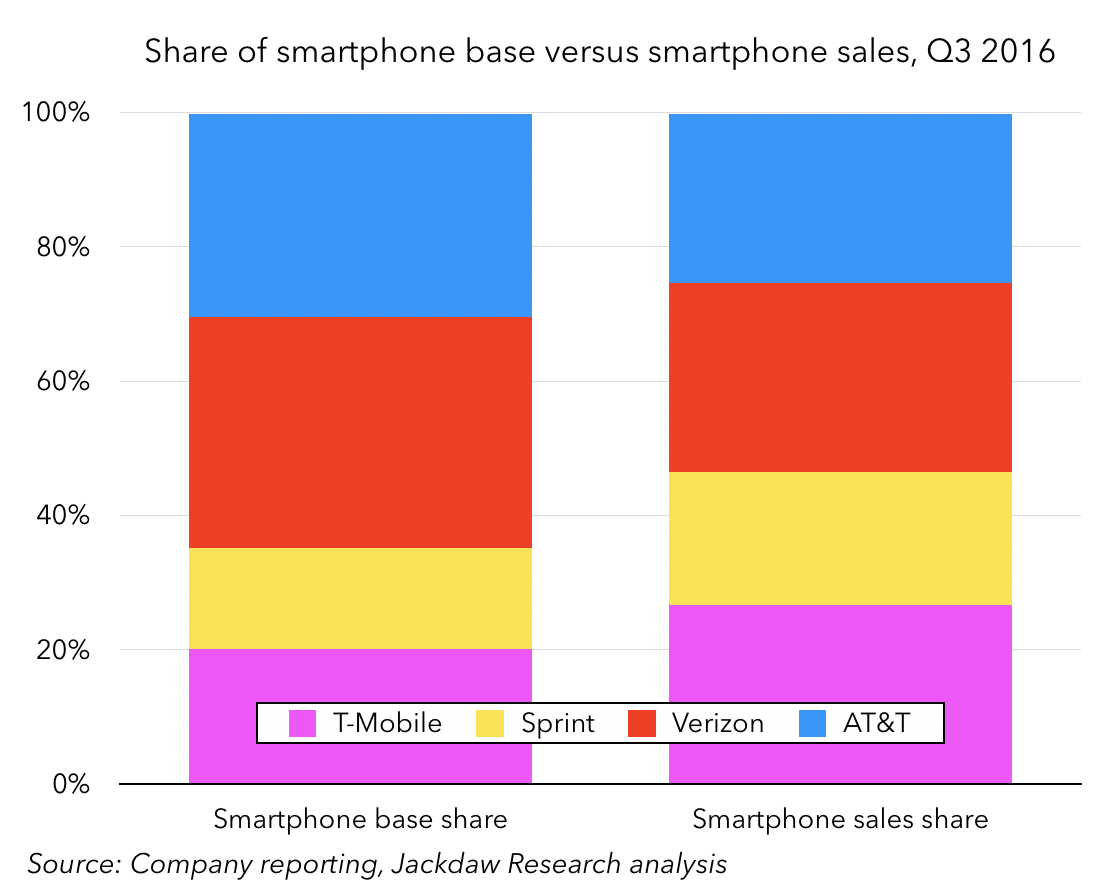
smartphone-base-versus-sales

As you can see, T-Mobile’s share of sales is far higher than its share of the base, while AT&T’s (and to a lesser extent Verizon’s) is far lower.

Growth beyond phones

So, if postpaid phone growth is slowing, growth has to come from somewhere else, and that’s very much been the case. Tablets had been an important source of growth for some of the carriers for a few years, but their aggressive pursuit has begun to cost them dearly now, at least in the case of Sprint and Verizon. Both carriers had promotions on low-cost tablets two years ago and are now finding that buyers don’t feel the need to keep the relationship going now their contracts are up. Both are seeing substantial tablet churn as a result, and overall tablet net adds are down by a huge amount over the past year:
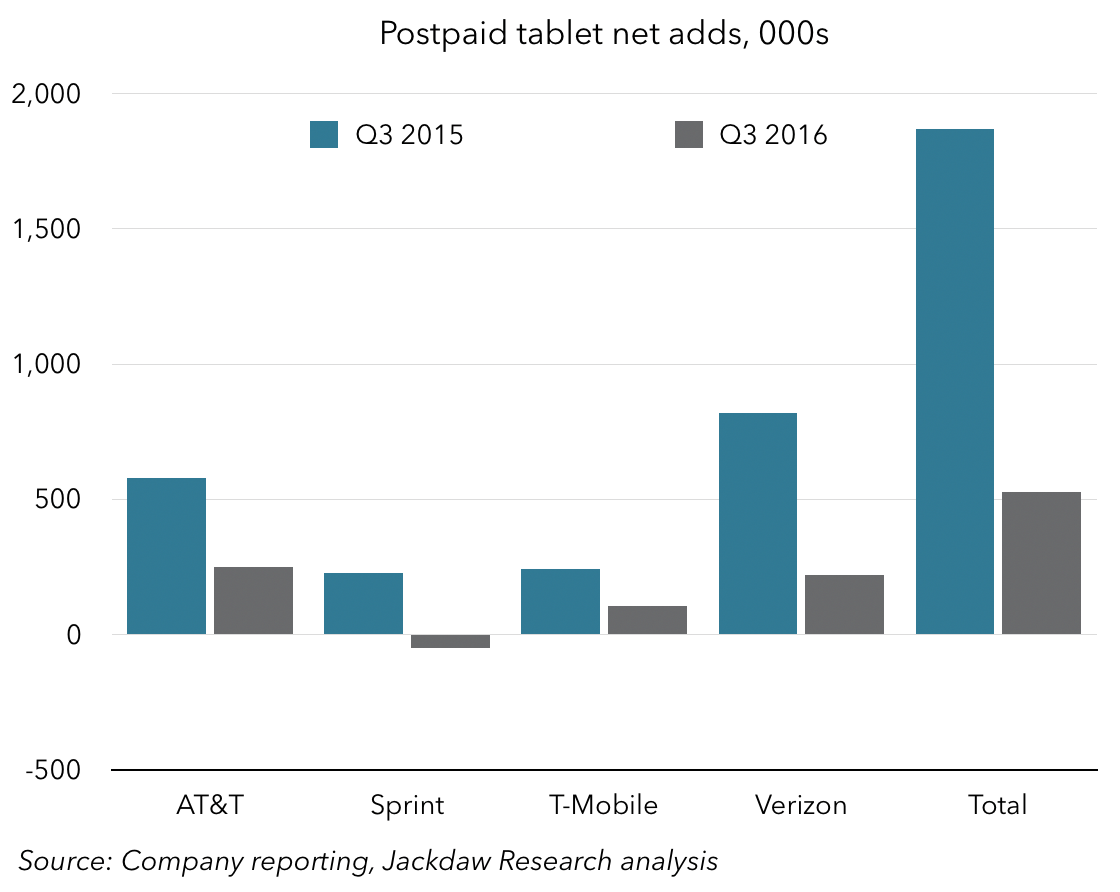
tablet-net-adds

There may be some recovery in tablet growth as Verizon and Sprint work their way through their churn issues, but I suspect this slowing growth is also reflective of broader industry trends for tablets, which appear to be stalling. Still in postpaid, there’s been a little growth in the “other” category, too, but that’s mostly wireless-based home phone services, and it’s not going to drive much growth overall. So, the industry likely needs to look beyond traditional postpaid services entirely.

Prepaid isn’t growing much faster

The next big category for the major operators is prepaid, which has gone through an interesting evolution over the last few years. It began as the option for people who couldn’t qualify for postpaid service because of poor credit scores, and was very much the red-headed stepchild of the US wireless industry, in contrast to many other markets where it came to dominate. But there was a period a few years back where it began to attract customers who could have bought postpaid services but preferred the flexibility of prepaid, especially when prepaid began to achieve feature parity with postpaid. However, that ebbed again as installment plans took off on the postpaid side and made those services more flexible. Now, we’re going through yet another change as a couple of the big carriers use their prepaid brands as fighter brands, going after their competitors’ postpaid customers. The result is that those two carriers are seeing very healthy growth in prepaid, while the other operators are struggling. In the chart below, I’ve added in TracFone, which is the largest prepaid operator in the US, but not a carrier (it uses the other operators’ networks on a wholesale basis):

prepaid-net-adds

As you can see, AT&T (mostly through its Cricket brand) and T-Mobile (mostly through its MetroPCS brand) have risen to the top, even as Sprint has gone rapidly downhill and Verizon and TracFone have mostly bounced around roughly at or below zero. There is some growth here, but it’s all being captured by the two operators, while the others are treading water or slowly going under.

Connected devices – the fastest-growing category

The fastest-growing category in the US wireless market today is what are called connected devices. For the uninitiated, that probably requires something of an explanation, since you might think of all wireless connections as being connected devices. The best way to think about the connected devices category is that these are connections sold for non-traditional things, so not phones and mostly not tablets either, but rather connected cars, smart water meters, fleet tracking, and all kinds of other connections which are more about objects than people. The one exception is the wireless connections that get bundled into some Amazon Kindle devices as part of the single upfront purchase, where the monthly bill goes to Amazon and not the customer.

This category has been growing faster than all the others – the chart below shows net adds for the four major categories we’ve discussed so far across the five largest operators, and you can see that connected devices are well out in front over the past year or so:comparison-of-net-adds
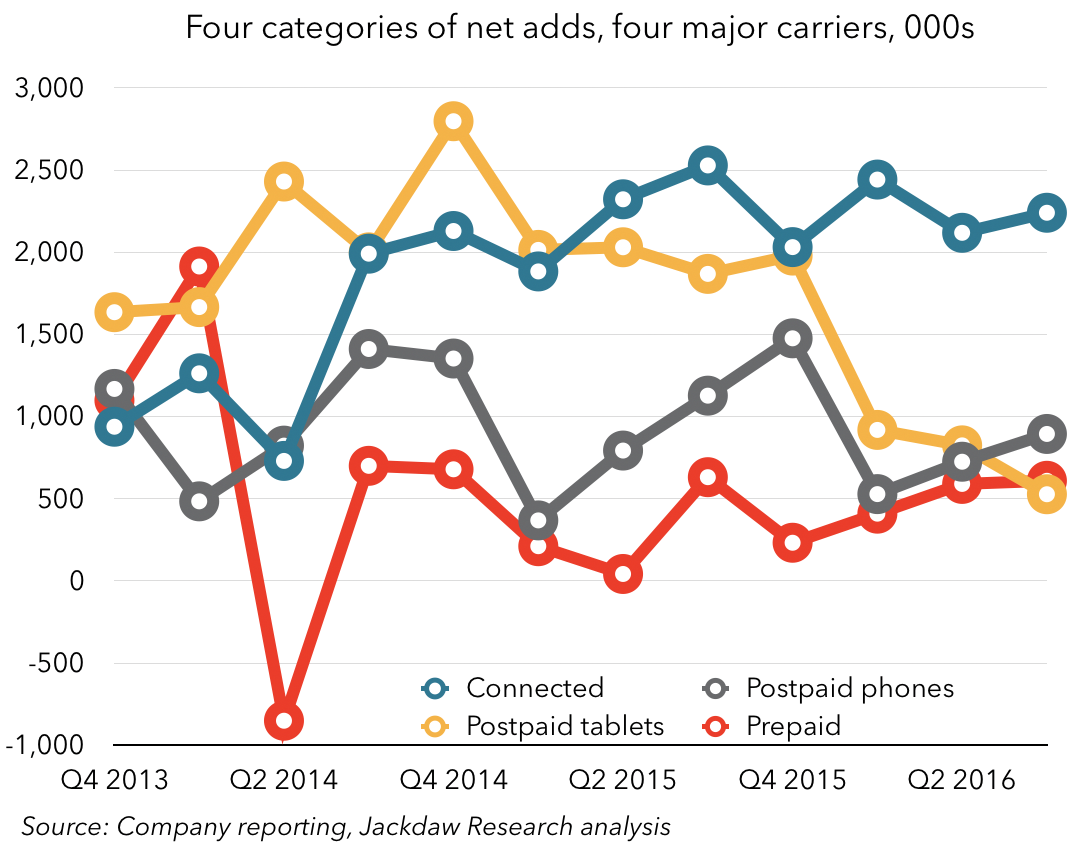
Growth in this category, in turn, is dominated by two operators – AT&T and Sprint, as shown in the chart below (note that Verizon doesn’t report net adds in this category publicly):connected-devices-net-adds
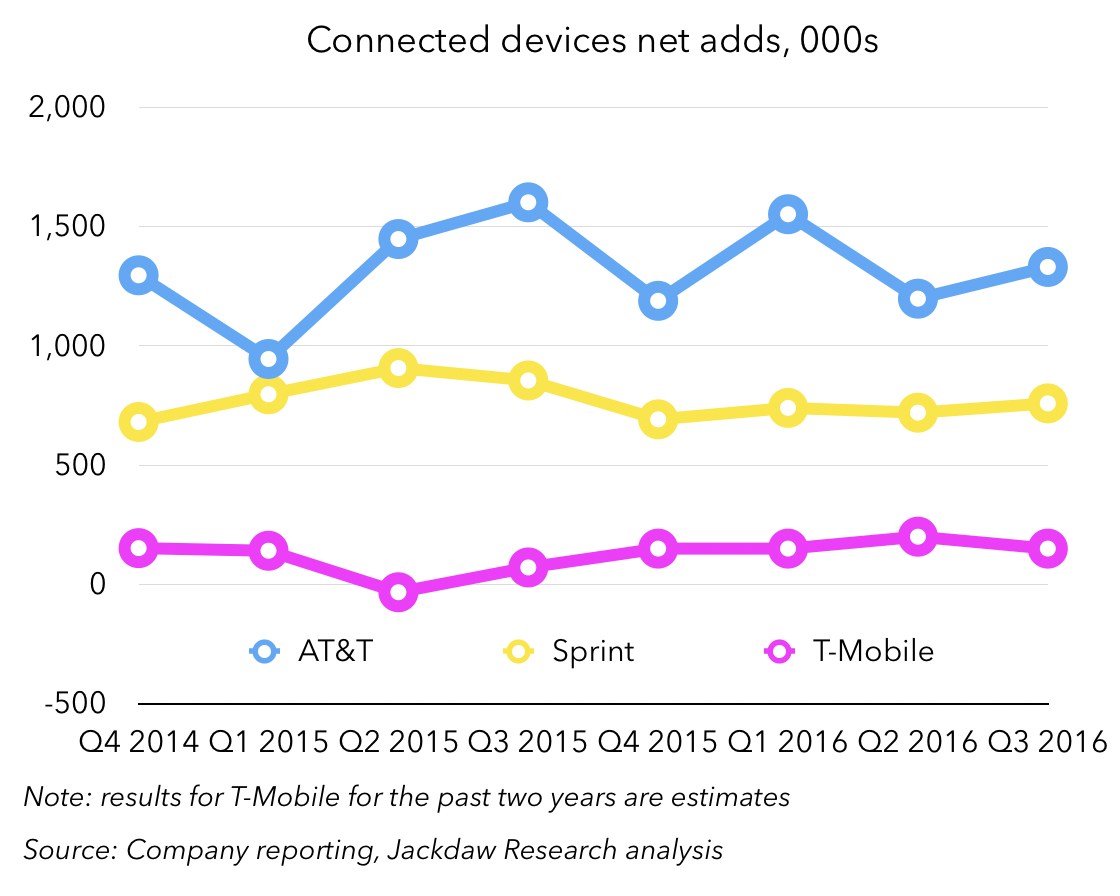
At AT&T, many of these net adds are in the connected car space, where it has signed many of the major car manufacturers as customers. The rest of AT&T’s and most of Sprint’s are a mix of enterprise and industrial applications, along with the Kindle business at AT&T. T-Mobile also has a much smaller presence here, and Verizon has a legacy business as the provider of GM’s OnStar services as well as a newer IoT-focused practice.

Though the connection growth here is healthier than the other segments, the revenue per user is much lower, in some cases only single digit dollars a month. However, this part of the market is likely to continue to grow very rapidly in the coming years even as growth in the core postpaid and prepaid markets evaporates, so it’s an important place for the major carriers to invest for future growth.
Uncovering the Reasons for T-Mobile’s One Launch

T-Mobile today announced its latest Un-Carrier move, Un-Carrier 12. The crux of the plan is new unlimited plans under the T-Mobile One brand. The headline from T-Mobile is about simplicity and unlimited for everyone, but the upshot of this new pricing is that the base price for postpaid at T-Mobile just went up quite significantly. And the reason for the move is that Un-Carrier is losing momentum and T-Mobile needs to boost growth again.

The context – slowing growth

I’ve written about this a little bit in the past, but here is the context: T-Mobile is losing momentum with its Un-Carrier moves. Two key metrics – postpaid phone net adds and porting ratios from other carriers – have both been falling.

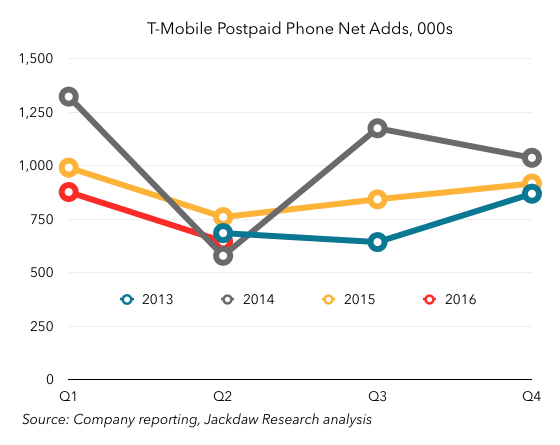
The chart below shows postpaid phone net adds on a quarterly basis, with one line for each year, so you can see how each quarter compares to the year-ago quarter:

TMO phone net adds 560px

As you can see, the 2016 quarters so far are below Q1 and Q2 in 2015, while Q2 was also below 2013, and Q1 was below 2014. In 2015, every quarter but Q2 was below 2014 net adds. So there’s a very clear trend now that T-Mobile is adding fewer phones each quarter than a year earlier. If you strip out the exceptional Q2 2014, when phone net adds dipped, the trend is now clear for a year and a half.

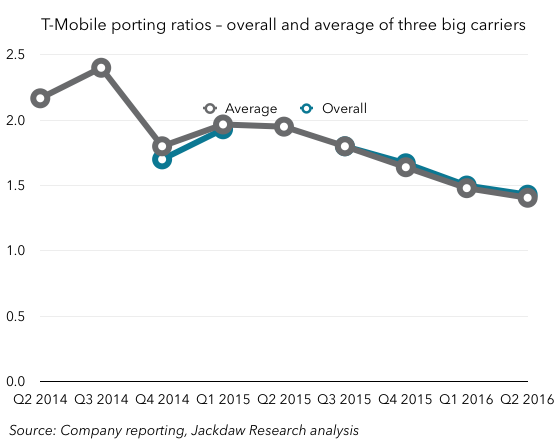
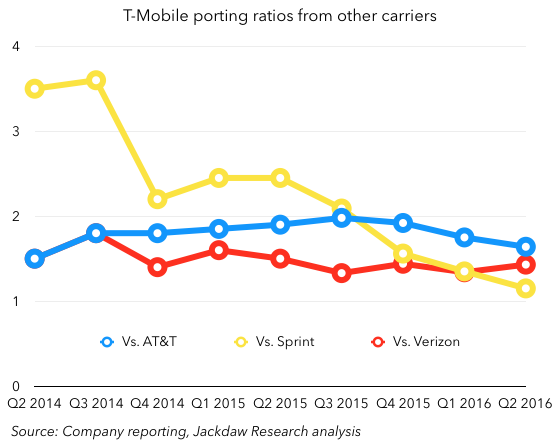
Moving to porting ratios, which T-Mobile reports on its earnings calls, the trend there is fairly clear too. It reports porting ratios against each of the other three major carriers, as well as an overall porting ratio most quarters. An average of the three individual carriers’ porting ratios tends to track fairly closely against the overall porting ratio, so I’ve included that in the second chart below to fill in some gaps:

TMO porting ratios 560px

TMO porting ratios overall 560pxThat second chart is probably the easiest one to read, because the trend is so clear. The overall rate peaked in Q3 2014 at just under 2.5, and has fallen since to under 1.5. Against individual carriers, the biggest change in the last two years has been Sprint, whose troubles two and three years ago allowed T-Mobile to capture massive numbers of subscribers, but whose recent improvements have made that cherrypicking much harder. I’ll stop here with the context, but it should be clear by now that T-Mobile is having less and less success with adding new customers and winning subscribers from competitors as time goes on, as its various Un-Carrier moves offer diminishing returns.

T-Mobile One – simplicity at a cost

T-Mobile is selling simplicity here – that’s the headline. It will have one plan going forward, and that plan will be unlimited, with a pricing structure that’s extremely easy to understand. In the context of recent pricing moves from competitors, that’s admirable, and attractive to customers. Unlimited is the simplest message of all, and has huge appeal in the peace of mind it provides.

However, this change is coming at a significant price premium. T-Mobile’s current plans start at $50 for a single line, with 2GB of data. A second line at that price costs $30 additionally, for $80 total. A third line is only $10, so $90 in total, and the same pricing continues for additional lines. Let’s compare this to the new pricing which will be offered from September 6, which will be the only pricing available for new customers:

TMO One Pricing 560px


The headline here is that, for the plans at 2GB and 6GB per line, the new pricing is more expensive, while for the plans at 10GB and the Unlimited plans, the new pricing is the same or cheaper. That’s significant, because T-Mobile says their most popular plans are the 6GB and 10GB plans, so a good chunk of their customers would be paying more on this plan, while many others would be paying roughly the same or slightly less. This helps to explain why T-Mobile says it doesn’t expect a meaningful change to its ARPU.

But of course for new customers, the starting point is now $70 rather than $50, meaning that the entry point for new customers has gone up by $20 for a single line. Put another way, competitors who previously matched T-Mobile’s entry pricing now undercut it by $20 (and Sprint has just launched new pricing today). So, even though the headline is all about simplicity and the gift of unlimited, the reality is that customers coming in at the low end will end up paying more than they would have before, and potentially more than they would at competitors.

The reason for the shift to unlimited

Here’s the rub, though, with this whole thing: T-Mobile introduced BingeOn, its video throttling strategy, a year ago. That did two things: it made it much more economical for T-Mobile to offer bigger and unlimited data plans, because it cut bandwidth usage dramatically; but it also meant that many customers who would otherwise have been on the standard trajectory of ever increasing usage pushing them into ever bigger data buckets instead went backwards. The same consumption of video suddenly drove far lower usage. The result is that T-Mobile doesn’t have the same driver of ARPU that almost every other carrier does, because it kneecapped data growth.

There’s an analog here with what happened with all the carriers a few years back when it became clear that voice and text usage were no longer going to grow as they had in the past, while data was going to continue to grow rapidly. At that point, the best move from a financial perspective was to move away from metered voice and text, because there was no longer upside for charging for every bit of usage, and instead only downside as usage dropped. On the other hand, it made sense to begin metering data and move away from unlimited plans, because that’s where the usage growth was, and where the future revenue opportunity would be too.

What T-Mobile is doing here is finding an alternative way to move people to higher tiered data plans even though they no longer need to. The appeal of unlimited is such that people will move to it even if they’re not close to hitting their current data cap, just for peace of mind. It’s even more likely that a T-Mobile customer would actually need to move to a higher plan when you consider that T-Mobile has offered Data Stash, which allows customers to roll over a data allowance over many months.

The cost of unlimited

T-Mobile made much today of the fact that its network was designed for unlimited, and that competitors’ networks were not. But that’s really another way of saying two things: T-Mobile is far smaller than its two major competitors, and so has far fewer customers on an national network, using far less data in aggregate; and with BingeOn, it’s reduced the data usage associated with video consumption by about two thirds.

But it’s not really about the network per se – it’s about the cost. Unlimited customers (for the most part) don’t actually use dramatic amounts of bandwidth in the average month. It’s likely that many of them would fit fine in the 5-20GB buckets offered by the carriers. But suddenly taking the limits off all customers risks significant increases in usage because it changes behavior dramatically, and that could incur significant costs in increased data capacity. So that’s a high-risk move, and it’s why most carriers don’t do this.

But anyone can offer unlimited if they price it right, which is why you see T-Mobile pricing it at roughly the same price as 10GB plans under its previous options. It’s also why streaming video up to 4K costs an additional $25 per line per month. There’s a cost to unlimited, and if it’s truly unlimited rather than being throttled to 480p, it costs more. This is really just a question of pricing, but that’s why T-Mobile’s pricing is going up here – it’s not magic, just economics.

A sign of confidence

The other thing that’s going on here is that T-Mobile is getting more confident in the performance of its network. One of the interesting facets of pricing in the US mobile market is that pricing power largely depends on perceptions of network performance. This is why Sprint can run campaigns offering 1% worse performance than Verizon at half the price and yet doesn’t see a massive influx of customers from its competitor. Network quality, but more importantly perception of network quality, requires certain carriers to charge less for the same services in order to win customers, while other carriers can charge more on the basis of their perceived better network quality.

Both Sprint and T-Mobile (and especially T-Mobile) have been increasing the quality of their networks in recent years, and perception on the T-Mobile side is finally starting to catch up with reality. It’s absolutely a sign of the company’s increased confidence in both its actual network and perceptions of its network that it’s willing to raise prices at this point. It clearly feels like it’s more able to compete with the big guys on network, and so can move its pricing more in line with theirs. That Sprint instead focuses on that 1% difference and 50% lower pricing is a sign that it’s not there yet, by a long stretch (leaving aside the wisdom of highlighting the worse performance of your network in national advertising).

The key to T-Mobile’s growth

T-Mobile reported its earnings this morning, and as usual lately there was a strong component of growth – across subscribers, revenues, and even average revenue per subscriber. I’m going to run through the highlights quickly, but then I’m going to drill down around what drives that growth, and how T-Mobile is able to grow at this rate even as its competitors struggle to do so.

Note: I’ve written extensively about T-Mobile before, and remain skeptical about some of the aspects of its business model and strategy, but this post will focus on the flip side of that: the undeniable growth in its business. In addition, you can find my analysis of other major tech companies’ earnings here, and you can subscribe to the Jackdaw Research Quarterly Decks service if you want to get a full set of charts on the major tech companies and on the US wireless, cable, satellite, and telecoms operators.

Quick growth review

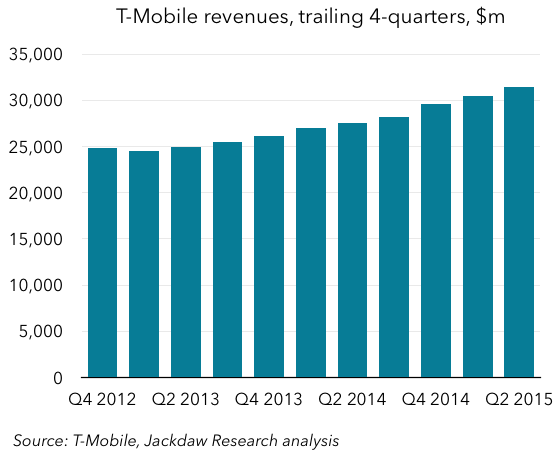
The two charts below show all you really need to know about growth at T-Mobile – from stagnation and decline pre-2013, the company has turned itself around dramatically, growing subscribers at a now fairly steady pace of 15-18% per quarter, and as a result revenues have been growing too.TMO subscriber growthTMO revenues

How does T-Mobile do it?

So, the big question becomes how T-Mobile is able to achieve this, when the other three major US carriers are not able to do so. Verizon’s year on year wireless revenue growth has been around 5-10%, AT&T’s has recently been in the low single digits, and Sprint’s has been negative for several quarters. Subscriber growth at T-Mobile’s two largest competitors – AT&T and Verizon – has been stronger, but largely driven by things other than phones, whereas T-Mobile’s growth has been almost entirely based on the traditional phone business. That’s a liability in some ways, because the base of phones in the US isn’t really growing much anymore, but at the moment T-Mobile is capturing what growth there is, while stealing subscribers from competitors. I’m going to focus mostly on postpaid in most of the analysis below, because that’s where T-Mobile’s growth is largely coming from.

The key to T-Mobile’s growth is the combination of two separate effects: churn (subscriber losses) and gross additions (the new customers a carrier adds). Simply put, the net subscriber additions number that most analysis of the wireless industry focuses on is the net result of these two forces. However, when you just focus on that number it’s easy to miss how these two come together in very different ways for the different carriers. What T-Mobile is doing uniquely well is combining very low churn (subscriber losses) with high gross additions (new customers). Note that T-Mobile and the other carriers typically don’t report their actual postpaid subscriber losses or gross additions directly, but given their churn and net addition numbers we can do a fairly straightforward calculation that gets us there with a reasonable degree of accuracy.

Churn – far lower than in the past, and at smaller scale

Churn is the first aspect of this equation. Briefly, the reported churn number is the average percentage of the subscriber base that leaves the carrier during each month of the quarter. So, if churn is 1%, that means that on average during the quarter 1% of the subscriber base stopped being a customer, and that in turn means that around 3% left during the quarter. The US carriers generally report churn for their two major sets of customers – postpaid and prepaid – because churn rates are very different for these two groups. Prepaid churn is far higher than postpaid, because these customers can more or less come and go as they please, without contracts, device payments, or anything else to make it hard to leave. T-Mobile has very successfully lowered its postpaid churn over the past couple of years, and this is a major component of how it’s turned its growth around:

TMO churnT-Mobile has actually switched from metric to another during the period shown – first reporting total postpaid churn (including devices like tablets and modems) and now reporting phone churn specifically. As you can see, the combined number has fallen from 2.5% in 2012 to 1.3% now. That might not seem a lot – these numbers sound pretty small – but remember that that’s a monthly churn rate, so the quarterly churn is three times as high, and during the course of a year, a 2.5% churn rate means you lose 30% of your customers, whereas a 1.3% churn rate almost halves those losses.

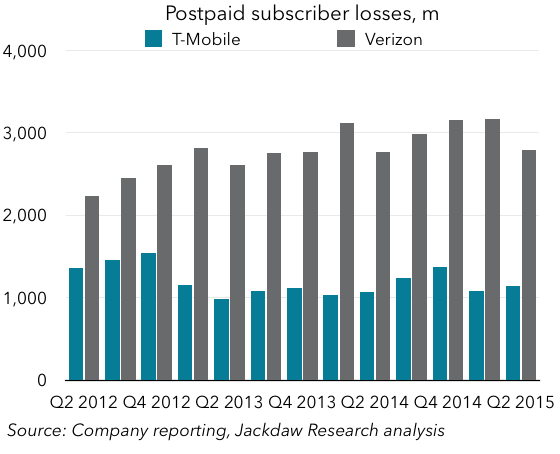
Of course, how many subscribers you actually lose is a factor not just of your churn rate but also the size of your subscriber base. To make it more concrete, let’s look at what’s happened to actual subscriber losses implied by that churn during this time. To put it in context, we’ll compare these losses to Verizon’s, which has typically had the lowest churn rate in the industry at around 1%, but also the largest number of postpaid customers (over three times as many as T-Mobile). The chart below shows the subscriber losses each quarter implied by the company’s respective churn rates and subscriber bases:

Postpaid subscriber lossesAs you can see, each quarter Verizon loses somewhere around 3 million customers, even at its very low 1% churn rate, whereas T-Mobile’s slightly higher churn rate results in much lower losses – just over 1 million most quarters. So, right off the bat, even with a lower churn rate, Verizon has to win three times as many new subscribers as T-Mobile each quarter just to tread water. The combined effects of T-Mobile’s falling churn and its relatively small base give it a significant advantage over AT&T and Verizon (both of which have lower churn but much bigger bases) and Sprint (which has a very similar base but much higher churn).

T-Mobile adds half as many subs as Verizon

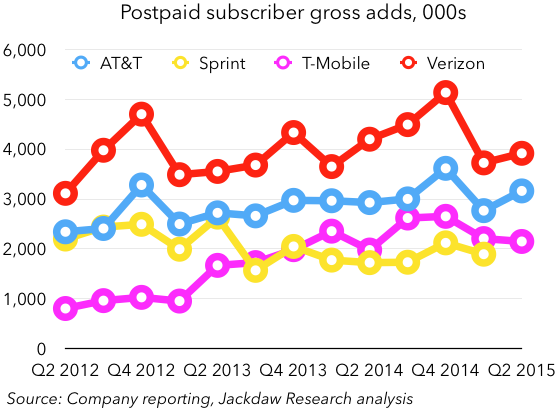
The other side, of the puzzle, then, is that these companies have to add enough new subscribers to at least offset the losses, but ideally quite a few more to drive subscriber growth. The chart below shows derived postpaid gross additions for the big four carriers (Sprint hasn’t reported Q2 results yet):Subscriber gross addsWhat you can see is that T-Mobile has far from the highest gross additions of the four carriers – in fact, last quarter its gross adds were just barely higher than Sprint’s. Verizon and AT&T both had significantly higher gross additions, driven in part by their far larger bases (many additions are additional lines sold to existing customers at this point) and their far larger marketing spend and to some extent store footprints. In short, T-Mobile isn’t winning more new customers than its major competitors – in fact, it’s in third place and fairly close to Sprint. Verizon actually adds roughly twice as many customers each quarter. The big difference is that low churn combined with its small base size, which combine for a much smaller loss of subscribers each quarter, and allow it a head start on growing subscribers.

Put another way, if T-Mobile had its current churn levels but was the size of AT&T or Verizon, it would currently be in last place rather than first place in net additions. AT&T and Verizon simply can’t grow phone gross additions much faster in the current, highly saturated, US phone market, so they’re pursuing growth where they can find it, which is in tablets and in new categories of connectivity like connected cars, home automation, and machine-to-machine communications. T-Mobile, however, benefits from its smaller scale (which is a liability in other ways) and from its good work in reducing churn rates, to the point that it’s consistently outperforming the other carriers in adding postpaid phone customers.

An increasing challenge

However, the larger T-Mobile gets, the more subscriber losses the same churn rates translate to, and the harder it will have to work to gain new subscribers. You can see from the earlier chart on subscriber losses that despite the progress on churn, losses aren’t falling, but rising. Despite a drop in churn from 1.48% in Q2 last year to 1.32% this year, losses actually rose slightly year on year, because that churn was on a base that had grown by almost five million. This will be an increasing challenge for T-Mobile, which is going to have a bigger hole to fill each quarter with new subscriber additions, even at a time when competitors are competing more aggressively and some of the lowest-hanging fruit for T-Mobile has been plucked.

DISH T-Mobile makes sense except for broadband

The rumors of a DISH-T-Mobile combination make a lot of sense. This is the comment I sent to several reporters last night:

This deal makes perfect sense. Given the increasing consolidation in the market, T-Mobile and DISH were in danger of becoming the lone single-service providers left in the market, with everyone else combining TV, broadband, and wireless. T-Mobile has a growing subscriber base and network but not enough spectrum, while DISH has lots of spectrum and no network, so their assets are very complementary. This merger would also go some way to overcoming some of T-Mobile’s lack of scale compared to its larger competitors, AT&T and Verizon.

Ina Fried had a more colorful formulation of the same basic idea in her piece over at Recode:

A deal between Dish and T-Mobile is akin to two people who hook up because they are the last ones left in the bar at closing time.

I think there’s a lot of logic to the deal, and it also fits with something John Legere said on T-Mobile’s Q1 earnings call about the synergies between wireless and pay TV:

I have always said on consolidation, it’s not a matter of if it’s when and how and now I’m going to add and who, because I think as we think ahead you need to think I still reiterate that in five years we will think it comical that we thought about the industry structure as the four major wireless carriers and as I said before and as Mike says many times as content and entertainment and social are moving to the internet and the internet is moving mobile, these industries, the adjacent industries are in the same game that we’re in. So whether it’s what you see Google doing. What you see the social media companies is doing or as you start to see cable players trying to move content Wi-Fi integration with mobile network et cetera, these are individual customers that are looking at both offer sets. So I think you need to think about the cable industry and players like us as not competitors but potential partners and alternatives for each other in the future.

So I think once you broaden the definition of things and I think in my mind the fixed wire and home broadband industry is the one that was of a concern there, but when you start to broaden the definition as I said of content and entertainment and video going to customers on fixed and mobile devices together and you start thinking of that industry is a far more broad set of potential partnerships integrations and mergers that the United States could be looking at and in that case I think you will see consolidation of a much broader set.

I’ve been somewhat skeptical of T-Mobile’s Un-Carrier moves, as I’ve written about quite a bit here in the past, but there’s no denying it’s disrupted the industry and created some useful innovation for consumers. Now imagine that same attitude applied to the pay TV market, and things could get really interesting.

Broadband is the elephant in the room

However, I think the elephant in the room here is broadband. Yes, T-Mobile’s LTE network is growing all the time, but wireless networks simply aren’t an efficient way to deliver broadband to the home, especially if users are expecting to be able to stream video services at increasingly high quality. Even with the combined spectrum of the two companies, there’s no way they can provide the 100-200GB of monthly bandwidth many consumers are going to be consuming. So, T-Mobile and DISH together can provide a useful bundle of mobile voice and broadband together with pay TV, but if consumers want to use Sling TV or any other over-the-top video services, that combination isn’t going to cut it, and neither mobile nor satellite broadband technology is going to solve that problem any time soon. So that’s my biggest question about the merger. I’m curious to see how the companies plan to address this if they end up announcing something.

Importantly, AT&T-DirecTV faces to some extent the same problem, but AT&T does have broadband in a significant part of the US, so this is a regional, rather than national problem. So it’s not quite the same.

Google’s MVNO ambitions

This is a post I had intended to write a few weeks back, when the Google MVNO rumors first started circulating, but never got around to. With Sundar Pichai’s remarks at Mobile World Congress this week rekindling the topic, I thought I’d finally set down by thoughts on this story. I haven’t been completely silent on this topic – I’ve tweeted about it quite a bit, talked to a few reporters, and discussed it on the Techpinions podcast (skip to 21:35). But I wanted to pull my thoughts together here in a coherent fashion. I’m pasting a transcript of my remarks on the podcast at the bottom of this post, because it sums this up pretty neatly, but I’ll expand a bit on the detail here.

The two rules of MVNOs

If you don’t know much about MVNOs, I’ll give you a quick primer. The first thing to know is that an MVNO is a mobile virtual network operator, which means these companies don’t own their own networks, but instead buy “airtime” (minutes, data etc) on a wholesale basis from those who do. In some markets such wholesale arrangements are mandated and regulated, but in others (including the US), both the arrangements themselves and the pricing are left to individual operators.

All this gives rise to what I like to think of as the two rules of MVNOs:

  • You can never be truly disruptive to the company whose network you’re using, because it always has the power to shut your business down
  • Wireless carriers will never support you as an MVNO unless they believe you can reach a niche or segment they can’t reach as effectively directly, rather than competing directly with them.

Partly as a result of these rules, despite the success of MVNOs in certain other markets, they’ve largely failed in the US, with many going out of business or being acquired by their host network operators. The one exception is Tracfone, which uses several major operators’ networks and targets largely low-end prepaid subscribers most of the carriers don’t want to own directly.

What this means for Google

All of which brings us to Google’s reported ambitions in the MVNO space, which are allegedly based on some sort of cooperation with T-Mobile and Sprint. In addition to the two rules above, the third thing worth bearing in mind here is most carriers’ view of Google. Google is one of the two companies that already has the most leverage over the carriers today, along with Apple. While Apple has arguably been more disruptive to most carriers with its refusal to pre-install carrier software, its direct retail and customer service relationships with many customers, its FaceTime and iMessage offerings which compete with carrier voice and text messaging and so on, Google has already demonstrated that it’s perfectly willing to disrupt carriers’ businesses too. Google Fiber, Hangouts, Google Voice, Google Wallet, Android Pay, Google Maps and other products either have already disrupted or have the potential to disrupt services offered by carriers. With both Apple and Google, carriers are already looking for ways to reduce their dependence on them and to temper their influence and power with end users.

Taking the two MVNO rules and these opinio

© 2025 Beyond Devices